About neck lift
The neck betrays age faster than the face. Platysmal banding, submental fullness and skin laxity combine to blur the line between jaw and neck, and no amount of weight loss corrects the muscular component.
Treatment is tailored to which of the three elements dominates. A patient in their thirties with good skin and isolated submental fat may need liposuction alone. Someone with visible bands and skin excess needs formal platysmaplasty with lateral suspension.
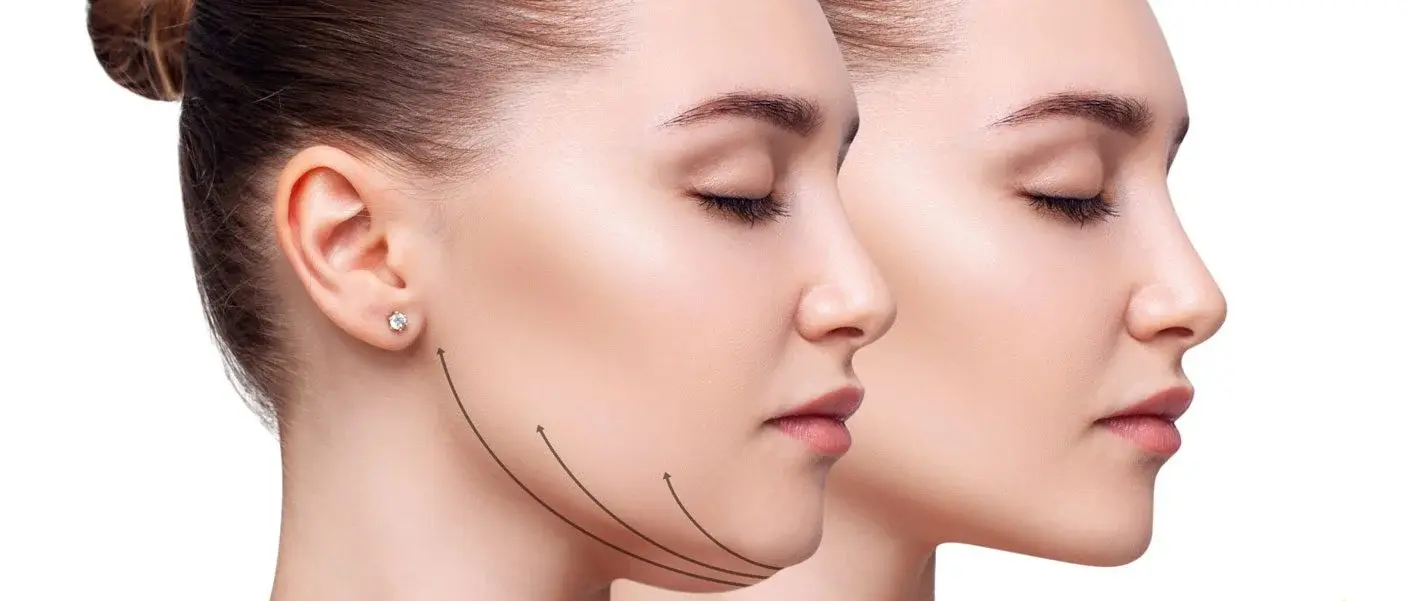
Because the neck and lower face share the same anatomy, a neck lift is most often performed with a facelift. Performed alone it still delivers a substantial change in profile, particularly for patients whose primary complaint is the "double chin" that persists despite being lean.
Who this suits
- Loss of definition between the jawline and neck.
- Vertical platysmal bands visible at rest or on animation.
- Submental fullness that has not responded to weight loss.
- Reasonable skin elasticity; significant laxity may require combining with a facelift.
- Stable weight and no untreated thyroid enlargement.
How the procedure is performed
- Assessment of fat compartments, platysmal tone, hyoid position and skin quality.
- Small incision under the chin, with additional incisions behind the ears where skin redraping is needed.
- Liposuction or direct excision of subplatysmal and supraplatysmal fat.
- Midline platysmal plication — the bands are sutured together to create a corset effect.
- Lateral platysmal suspension to the mastoid fascia for durable support.
- Digastric muscle and submandibular gland reduction in selected patients with deep fullness.
- A supportive garment worn continuously for the first week.
What it achieves
- Sharp, defined cervicomental angle.
- Elimination of visible platysmal bands.
- Improved jawline definition in profile.
- Scars limited to under the chin and behind the ears.
- Result durable for a decade or more.
Recovery timeline
Individual recovery varies. These are the stages most patients pass through, and the ones we plan your follow-up around.
- Days 1–3
Compression garment worn day and night. Swelling and tightness expected. Soft diet.
- Days 7–10
Sutures removed. Garment reduces to night-time wear.
- Weeks 2–3
Return to desk work. Bruising resolved; swelling still settling.
- Weeks 4–6
Full exercise. Neck feels tight on rotation — this eases over subsequent weeks.
- Months 3–6
Final contour, scars fading.
Cost
Standalone neck lift. Substantially discounted when combined with a facelift, as theatre and anaesthesia are shared.
Bands reflect the genuine variation in complexity between patients. Your firm quote is issued after examination and does not change afterwards. See our full price list for context across the catalogue.
Frequently asked questions
Yes, and it is a common request from patients in their late thirties and forties whose face is holding up well but whose neck is not. If there is significant jowling, however, treating the neck alone can look incongruous.
Only if the skin has good elasticity and the platysma is intact — typically patients under about forty. Otherwise removing fat without tightening leaves the skin loose.
Injectable deoxycholic acid can reduce modest submental fat over several sessions. It does nothing for muscle banding or skin laxity, so it suits a narrow group of patients. We do not provide it, and we will tell you if you fall into that group rather than sell you an operation.
Continuously for the first seven days, then nights only for a further three weeks. Compliance here materially affects the final contour.