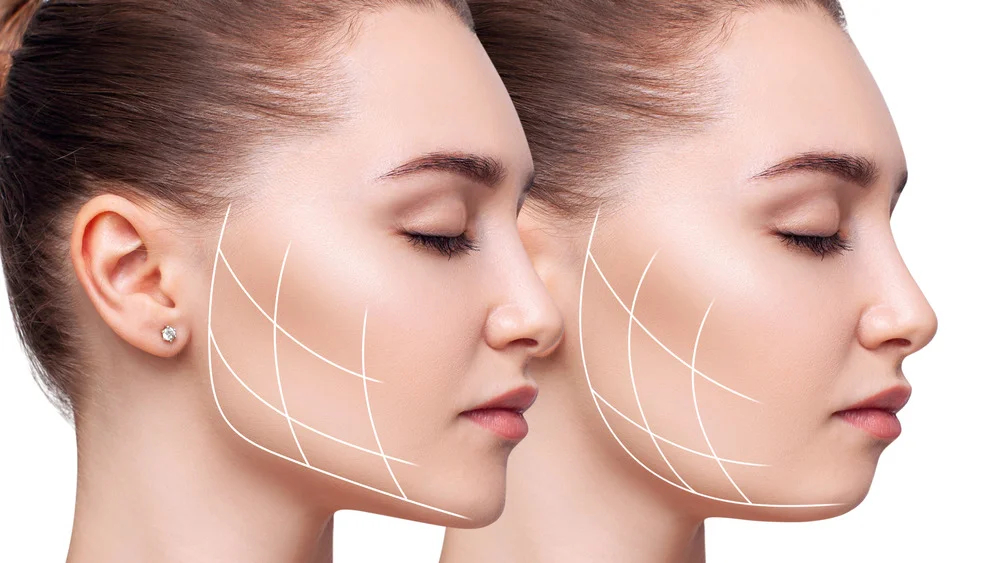
About chin & jaw
Facial balance in profile depends on the relationship between nose, lips and chin. A retruded chin throws that relationship out and is commonly misdiagnosed by patients as a nasal problem. We routinely show patients a profile simulation with the chin corrected and no nasal change, and a meaningful proportion choose that route instead.
Two approaches exist. Alloplastic implants — silicone or porous polyethylene — are placed over the bone through an incision under the chin or inside the mouth, and are quick, adjustable and reversible. A sliding genioplasty cuts and advances the chin bone itself, giving greater movement and correcting vertical height as well as projection.
Jaw angle augmentation widens and squares the lower face, and is increasingly requested by both male patients seeking definition and by gender-affirming patients. Where the aim is a softer or narrower jaw, reduction of the mandibular angle or masseter treatment is the reverse operation.
Who this suits
- A chin that sits behind the vertical line dropped from the lower lip in profile.
- A poorly defined jawline in a patient of normal weight.
- Facial asymmetry involving the lower third.
- Complete facial skeletal growth — typically 18 and over.
- Healthy dentition and no untreated bite abnormality requiring orthognathic surgery instead.
How the procedure is performed
- Cephalometric and photographic profile analysis with simulation.
- CT-based planning for custom implants where anatomy is asymmetric.
- Implant route: incision under the chin or intraorally, subperiosteal pocket, implant fixed with a titanium screw to prevent migration.
- Sliding genioplasty route: intraoral incision, horizontal osteotomy, advancement and plate fixation.
- Jaw angle implants placed intraorally for width and squaring.
- Concurrent submental liposuction where the fat pad blurs the new contour.
- Chin strap dressing worn for the first week.
What it achieves
- Balanced profile without altering the nose.
- Defined jawline and improved cervicomental angle.
- Options that are reversible (implant) or permanent (genioplasty).
- No visible external scar with the intraoral route.
- Result visible immediately, refining as swelling settles.
Recovery timeline
Individual recovery varies. These are the stages most patients pass through, and the ones we plan your follow-up around.
- Days 1–3
Chin strap worn continuously. Swelling and tightness. Soft diet if the intraoral route was used.
- Days 5–7
Strap reduced to night wear. Sutures removed if external.
- Weeks 2–3
Back to work. Numbness of the lower lip and chin is common and temporary.
- Weeks 4–6
Normal diet and exercise. Sensation returning.
- Months 3–6
Final contour; sensation fully recovered in the great majority.
Cost
Chin implant from $1,300; sliding genioplasty from $2,550; custom CT-planned jaw implants quoted individually.
Bands reflect the genuine variation in complexity between patients. Your firm quote is issued after examination and does not change afterwards. See our full price list for context across the catalogue.
Frequently asked questions
Implants are simpler, quicker and reversible, and suit straightforward horizontal deficiency. A genioplasty moves your own bone, corrects vertical height as well, and avoids a foreign body. We recommend based on how much movement is needed.
Chin filler is a genuinely useful way to trial the change before committing to surgery, and for mild deficiency it can be the final answer. It needs repeating every twelve to eighteen months. We do not offer injectables, so we will refer you for that trial if you want one.
Screw fixation prevents migration, which was the main historical problem. Modern implants do not have a shelf life and are not routinely replaced.
Sometimes both, often just the chin. We will show you the profile simulation for each and let the images make the case rather than talking you into either.