About arm lift
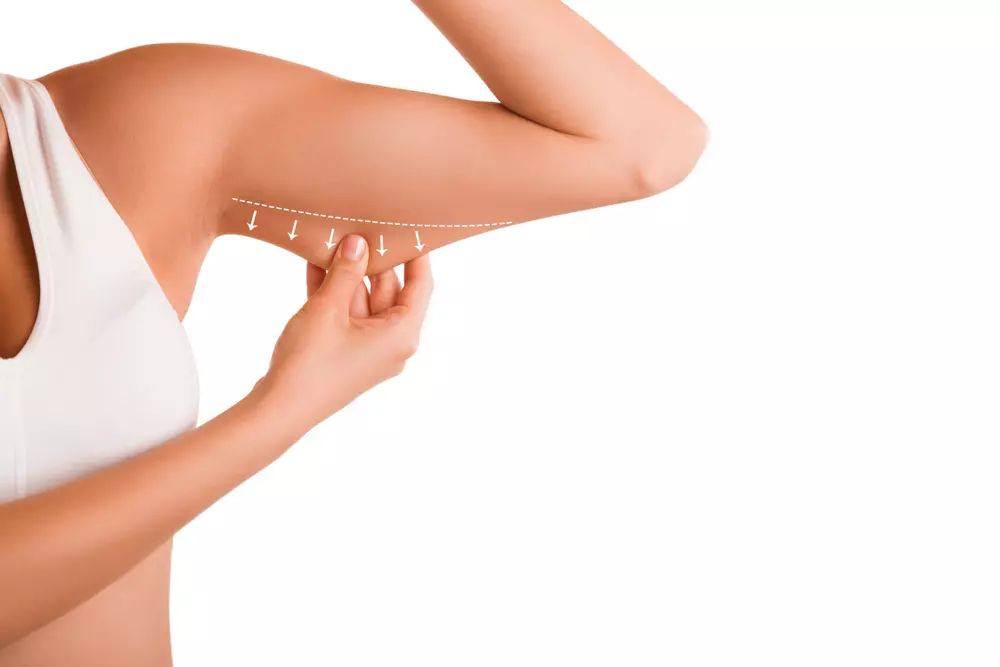
Upper arm laxity has two components: excess fat and excess skin. Where skin quality is still good, liposuction alone can be sufficient. Where the skin envelope has been stretched — typically after substantial weight loss — no energy device or liposuction will retract it, and excision is the only effective option.
The scar runs along the inner aspect of the arm from the axilla toward the elbow. We place it on the posteromedial surface where it faces the body rather than forward, so it is least visible in normal arm position. It is nonetheless a long scar and we make sure patients understand that before proceeding.
For patients with limited laxity confined near the armpit, a short-scar or mini brachioplasty confines the incision to the axillary crease. It corrects far less, but the scar is essentially hidden.
Who this suits
- Loose, hanging upper arm skin, usually after significant weight loss.
- Stable weight for at least six months.
- Acceptance of a permanent inner-arm scar.
- Non-smoker in good general health.
- No untreated lymphoedema or prior axillary node clearance without discussion.
How the procedure is performed
- Standing assessment of skin excess, fat volume and the vertical extent of laxity.
- Marking with the arm abducted to determine the precise resection pattern.
- VASER liposuction of the arm first to debulk fat while preserving the lymphatics.
- Excision of redundant skin along the posteromedial arm.
- Careful preservation of the medial antebrachial cutaneous nerve and the axillary lymphatics.
- Fascial anchoring to the axillary fascia to take tension off the skin closure.
- Layered closure with a T-junction at the axilla where needed, and compression sleeves worn for six weeks.
What it achieves
- Firm, contoured upper arms with the sagging removed.
- Elimination of skin chafing and the irritation it causes.
- Freedom to wear short sleeves and fitted clothing.
- Fascial anchoring keeps tension off the skin and produces a finer scar.
- Durable result provided weight remains stable.
Recovery timeline
Individual recovery varies. These are the stages most patients pass through, and the ones we plan your follow-up around.
- Days 1–3
Compression sleeves worn continuously. Arms elevated. Soreness with shoulder movement.
- Days 7–14
Sutures reviewed. Desk work resumed. Lifting restricted to light objects only.
- Weeks 3–4
Swelling settling. Gentle range-of-motion exercises encouraged.
- Weeks 6–8
Sleeves discontinued. Upper body training resumed progressively.
- Months 3–6
Contour settled; scars pink and firm — the stage at which patients need reassurance.
- Months 12–18
Scars mature and pale substantially.
Cost
Includes VASER liposuction of the arms, skin excision, compression sleeves and one year of follow-up.
Bands reflect the genuine variation in complexity between patients. Your firm quote is issued after examination and does not change afterwards. See our full price list for context across the catalogue.
Frequently asked questions
It is a long scar along the inner arm and it is permanent. Positioned posteromedially it is not visible from the front with arms at rest, but it will be seen when you raise your arms. This is the central trade-off and you should be comfortable with it before proceeding.
Only where skin elasticity is genuinely good and the problem is fat. After major weight loss it almost never is, and liposuction alone will leave the arm looking deflated.
For very mild laxity, marginally. For the degree of excess that leads people to seek brachioplasty, no device comes close to producing a comparable result.
Some transient swelling of the forearm and hand is common in the first weeks because arm lymphatics are disrupted. It settles. We preserve the axillary lymphatics deliberately to minimise it.