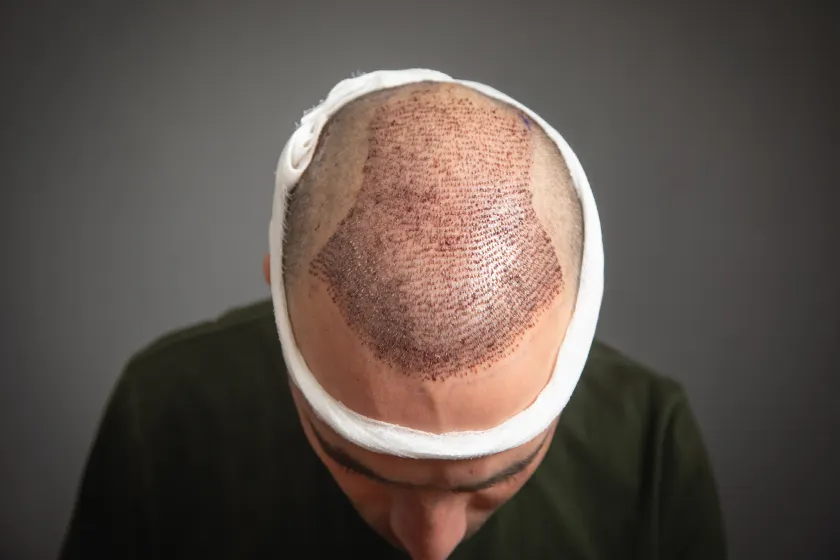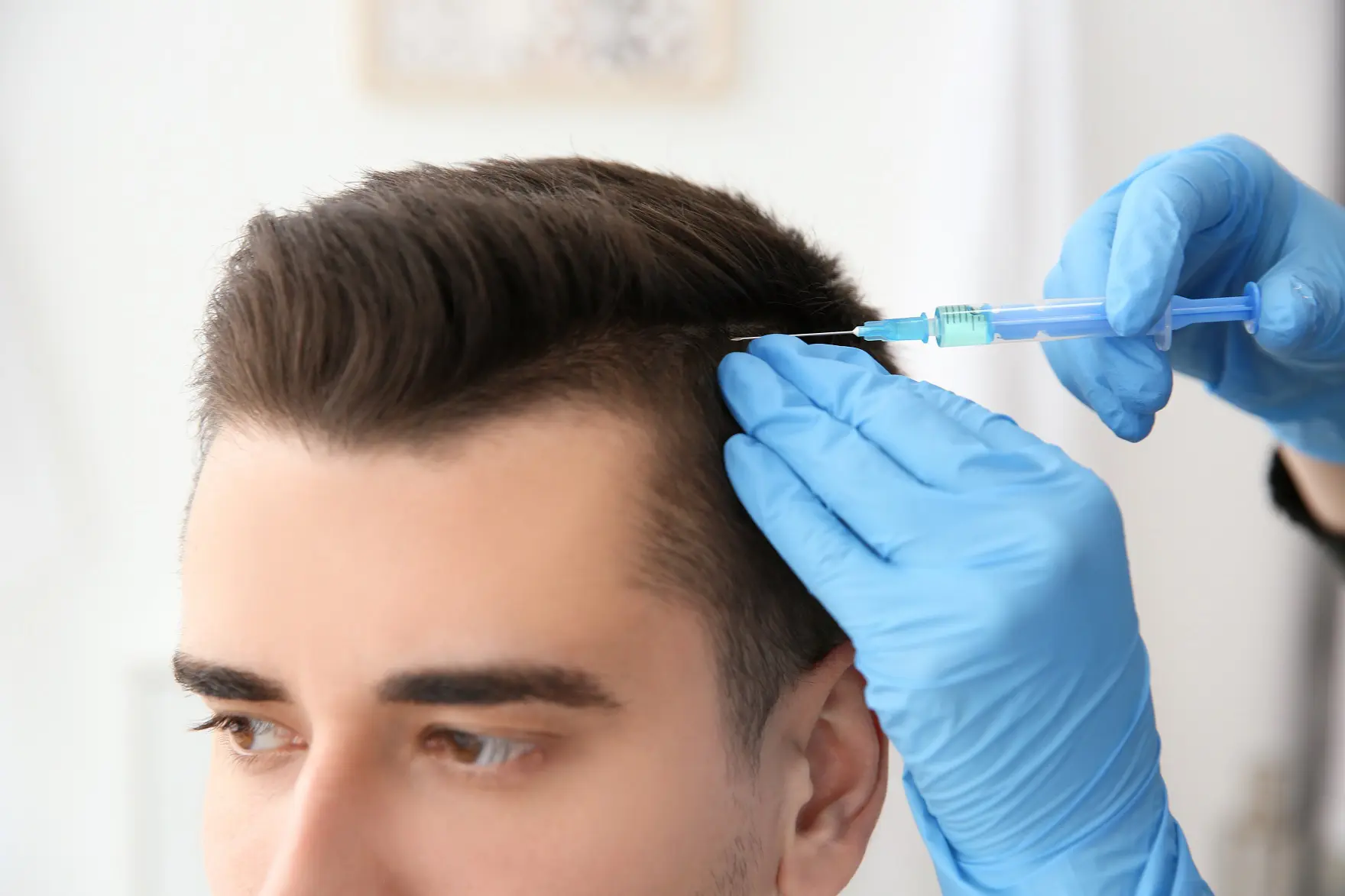
About fue hair transplant
Hair transplantation redistributes rather than creates. Follicles from the occipital and parietal donor zone are genetically insensitive to dihydrotestosterone, and they retain that property when moved — which is why grafts placed in a bald crown continue to grow for life.
Design is the part that separates a natural result from an obvious one. Hairline height and shape, temporal recession, the irregularity of the frontal hairline, and the angle and direction of every graft all have to match natural growth. A hairline that is too low or too straight will look wrong immediately and worse as the patient ages.
We plan for lifetime donor supply. A patient of 28 with early loss will very likely progress, and using the entire donor reserve on a dense low hairline now leaves nothing for the crown at 45. We plan conservatively and insist on concurrent medical therapy to protect the native hair around the grafts.
Who this suits
- Stable, established pattern hair loss — Norwood III or above in men.
- Adequate donor density in the occipital and parietal scalp.
- Age generally 25 and above, since operating on very early loss risks poor lifetime planning.
- Female pattern loss with a stable donor zone and a confirmed diagnosis.
- Not suitable in active scarring alopecia, unstable alopecia areata, or with unrealistic density expectations.
How the procedure is performed
- Trichoscopy, donor density measurement and Norwood or Ludwig grading.
- Blood investigations, including thyroid, ferritin and vitamin D.
- Hairline design drawn with you, standing, and photographed for approval before surgery.
- Local anaesthesia with a ring block; the patient remains awake and comfortable throughout.
- Graft harvest with 0.8–0.9mm micropunches, distributed across the donor zone to avoid patchiness.
- Graft sorting under magnification into single, double and triple units.
- Recipient site creation at matched angle and direction, with singles at the hairline and multi-unit grafts behind.
- Implantation using DHI implanter pens or forceps, with grafts kept in hypothermic storage throughout.
What it achieves
- Permanent growth — transplanted follicles retain DHT resistance.
- No linear scar; donor sites heal as tiny dots concealed by surrounding hair.
- Natural hairline design planned for lifetime progression.
- Single-session capacity of 2,000–4,000 grafts depending on donor supply.
- Local anaesthesia only, with same-day discharge.
Recovery timeline
Individual recovery varies. These are the stages most patients pass through, and the ones we plan your follow-up around.
- Days 1–3
Recipient area shows small crusts. Sleep elevated at 45 degrees. First wash performed in clinic at day three.
- Days 4–10
Daily washing per protocol. Crusts separating. Donor area healing well.
- Days 10–14
Crusts fully cleared. Presentable in most social settings; a cap is fine from day ten.
- Weeks 3–8
Shock loss — transplanted hairs shed. Expected, universal, and the stage patients find most alarming.
- Months 3–6
New growth begins, initially fine and wispy.
- Months 9–12
Density and calibre building steadily.
- Months 12–18
Final result with mature hair calibre.
Cost
Priced per graft, typically $0.45–$0.85 depending on technique and volume. Includes design, surgery, first wash, post-operative kit and follow-up to eighteen months.
Bands reflect the genuine variation in complexity between patients. Your firm quote is issued after examination and does not change afterwards. See our full price list for context across the catalogue.
Frequently asked questions
The transplanted hairs shed at three to eight weeks — this is shock loss and it happens to everyone. The follicles remain and regrow from month three. The final hair is permanent.
It depends on the area and the density you want. A frontal hairline typically needs 1,500–2,500; adding the crown pushes toward 3,000–4,000. We give an exact figure after measuring donor density.
Yes, unless it is protected. Transplanted hair is permanent but the native hair around it continues to follow its genetic course, which is why we insist on concurrent finasteride or minoxidil for most male patients.
FUE avoids a linear scar and suits short hairstyles, which is why we perform it almost exclusively. FUT can yield more grafts in one session and remains relevant for very large cases where donor supply is limited.
For a defined frontal area, usually. Extensive loss or continued progression may need a second session after twelve to eighteen months, and we plan donor supply from the start with that possibility in mind.
The ring block is the uncomfortable part and lasts a few minutes. After that the scalp is numb and most patients read, watch films or sleep through the session.